
A doctor’s note is a legitimate document a patient can provide to explain their absence from work. It’s short, specific to the visit, and signed by the treating doctor.
This article walks through three real doctor’s note examples: a note for time off work, a note clearing a patient to return to work, and a return to work doctor’s note with restrictions. We go through each note field by field, so you can see why every line is there and what the note leaves out on purpose.
What makes a doctor’s note legitimate
Most employers need a fixed set of details, and a legitimate doctor’s note includes all of them:
- Provider name and credentials
- Practice name, address, and phone number
- Date of the visit
- Dates the patient is excused from work, and the expected return date
- Restrictions, when the patient returns with limitations
- The provider’s signature
To see how each of these elements is written, read our guide on what to include in an urgent care doctor’s note for work.
3 real doctor’s note examples
The three notes below are examples, not real notes. The names, dates and numbers are made up. Treat them as a reference for what a complete note looks like.
Example 1: Doctor’s note for time off work
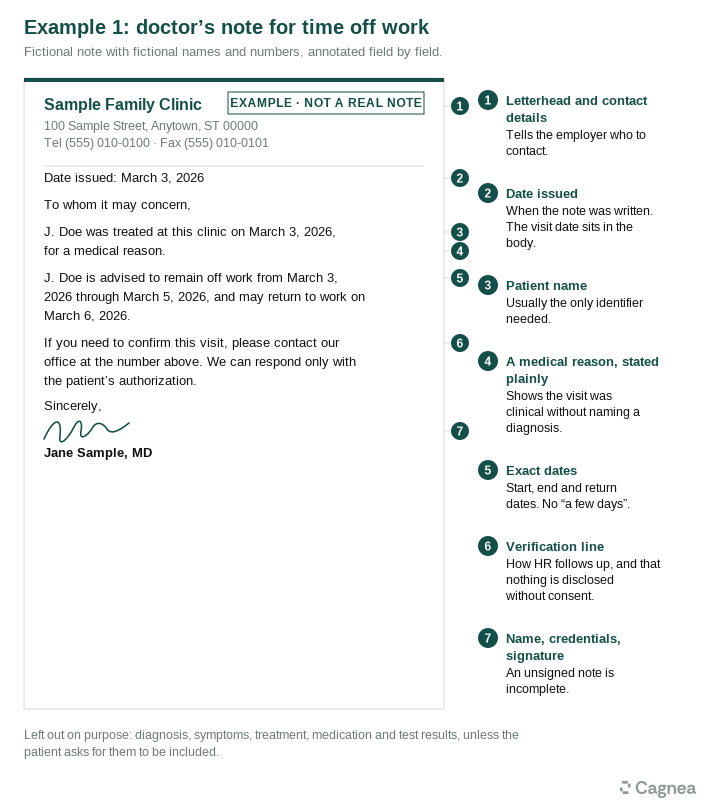
Field by field:
- Letterhead and contact details: These details tell the employer whom to contact if they need to speak to someone at the clinic. Without them, a doctor’s note loses its credibility.
- Date issued and date of visit: The issue date shows when the note was written. The visit date shows when the patient was actually seen.
- Patient name: Usually the only personal detail in the note. A note does not need any other identifier, such as a date of birth or address, unless the patient asks for it.
- A medical reason, stated plainly: The phrase “for a medical reason” is enough to show that the visit was clinical. No further explanation is needed.
- Exact excused dates: A start date, an end date, and a return date remove guesswork. A real doctor’s note won’t use vague words like “a few days” or “until better”, which leave the employer unable to record the absence.
- Verification line: This tells HR how to follow up and signals that the practice will not disclose anything without the patient’s say-so.
- Printed name, credentials, and signature: The provider’s name, qualifications and signature close the note. An unsigned note is an incomplete note.
What this note leaves out on purpose: Diagnosis, symptoms, treatment, medication, test results, and anything else about the condition. These are included only if the patient wants them and has consented.
Example 2: Return to work doctor’s note (cleared to return)
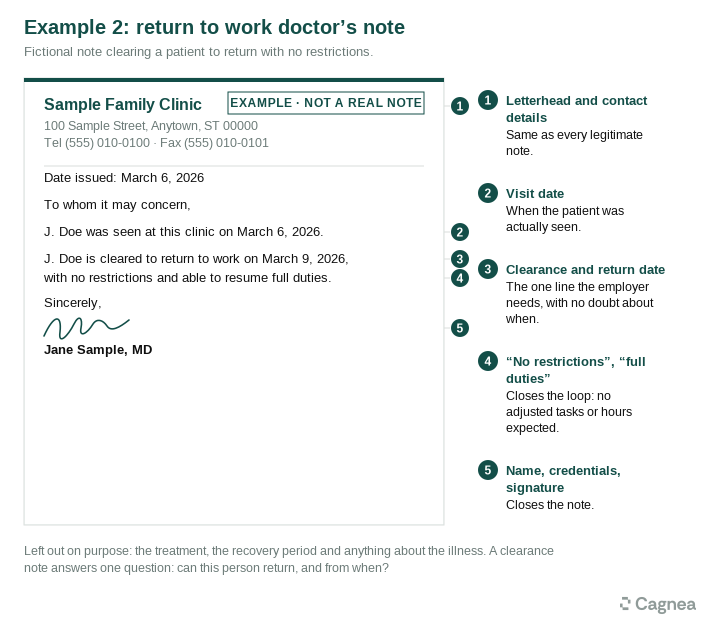
Field by field (fields not covered above):
- Clearance statement: The employer looks for wording like “cleared to return to work”. That single line from the doctor is the proof they need.
- Return date: Included so there is no ambiguity about when the employee can come back.
- “No restrictions” and “full duties”: This wording closes the loop. It tells the employer that no adjusted tasks or hours are expected.
What this note leaves out on purpose: Like the first example, this note does not describe the treatment, the recovery period, or anything about the illness. A clearance note only needs to answer one question: can this person return, and from when?
Example 3: Return to work note with restrictions
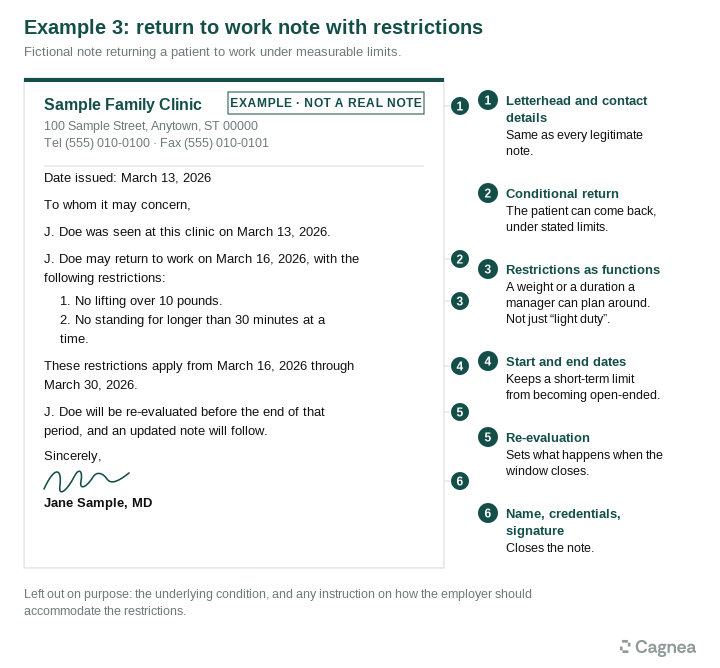
Field by field (fields not covered above):
- Conditional return: “May return to work… with the following restrictions” tells the employer that the patient can come back, and under what limits.
- Restrictions written as functions: Each restriction describes what the patient can or cannot do, using a measurable limit such as a weight or a duration. That gives a manager something concrete to plan around. A phrase like “light duty” with no detail is harder to apply.
- Start and end dates for the restrictions: The limits have a defined window, which keeps a short-term restriction from becoming open-ended.
- Re-evaluation: Stating that the patient will be reassessed and that an updated note will follow sets expectations for what happens when the window closes.
What this note leaves out on purpose: The restrictions describe what the patient can do, and the note stays silent on the underlying condition. It also does not tell the employer how to accommodate the restrictions.
How to tell a real note from a weak one
Weak notes usually fall short on completeness. Common gaps include:
- No traceable practice or doctor details
- No signature, or a signature with no printed name beside it
- Vague dates instead of specific ones
- Dates that do not line up, such as a visit date that falls after the excused dates, or an issue date that conflicts with the rest of the note
- A mismatch between detail and purpose: so little that the note says nothing, or so much clinical detail that it goes beyond what a work note needs
If HR needs to confirm a note, the safest route is to call the practice on a number found independently, such as its own website, rather than relying only on the number printed on the note. The practice can generally confirm details only with the patient’s authorization.
How a doctor’s note is made
Every example above is a short document that depends on a much longer one: the visit record. The dates, the restrictions, and the clearance all come from the clinician’s assessment and plan. When that record is complete, the note follows from it. When the record is rushed or rebuilt from memory, the note is where the gaps show.
That record usually follows the SOAP format, and the patient’s own account of their symptoms sits in its subjective section.
This is the problem Cagnea was built for. Cagnea is an ambient AI medical scribe that listens to the patient encounter as it happens and generates a structured SOAP note when the visit ends. The clinician reviews, edits, and signs, so the work note can be written from a complete visit record rather than left as a separate task at the end of the shift.
To see how the underlying documentation works in an urgent care setting, try Cagnea free for 14 days.
Frequently asked questions
What should a real doctor’s note for work include?
Provider name and credentials, practice contact details, the date of the visit, the dates excused from work, any restrictions, and a signature. See the examples above and our guide to what to include in an urgent care doctor’s note for work.
Does a doctor’s note have to include the diagnosis?
No. A diagnosis belongs in a work note only if the patient wants it mentioned and has given consent.
What is the difference between a time off note and a return to work note?
A time off note covers the dates a patient is away from work. A return to work note confirms when the patient can come back and whether any restrictions apply.
Is there a real doctor’s note example PDF I can download and fill in?
We do not provide a fillable or downloadable template. A legitimate note is written by the treating clinician from the actual visit, so the examples on this page are for reference only.
How long should a doctor’s note be?
A few lines are usually enough: the visit, the dates, any restrictions, and a signature.
Can an employer require a note for every absence?
That depends on the employer’s policy and the rules that apply in your location.


