SOAP is the most widely used format for writing a clinical note, and it’s an acronym for Subjective, Objective, Assessment, and Plan.
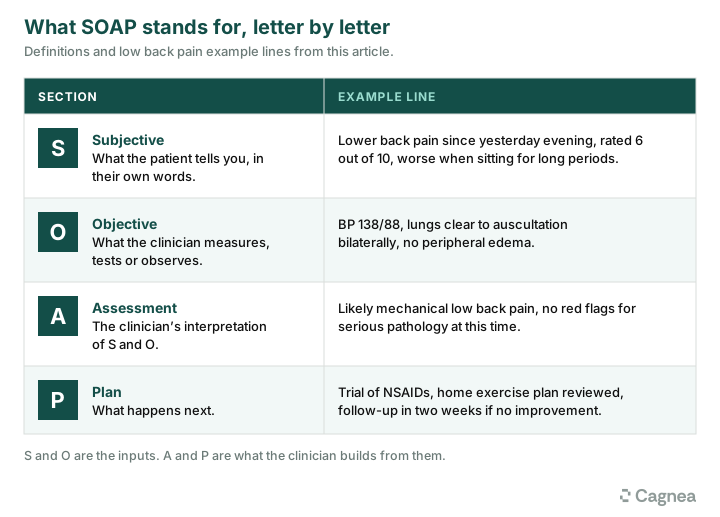
- Subjective: what the patient tells you, in their own words. It excludes everything the clinician thinks, assumes, observes, or tests.
- Objective: what the clinician personally measures, tests, or observes.
- Assessment: the clinician’s interpretation, based on the subjective and objective findings.
- Plan: the next steps the clinician recommends.
Those are the simplest definitions. Below, we go through what each letter means in practice, who uses the format, why it has lasted for nearly sixty years, and how SOAP differs from the other note formats you’ll come across.
What each letter means (with examples)
S: Subjective
If the patient says it, it’s recorded here: their symptoms, their pain, how they feel about their symptoms, and their medical history, all in their own words. None of it has been confirmed by the clinician.
Example: Patient reports lower back pain since yesterday evening, rated 6 out of 10, worse when sitting for long periods.
No tests have been done yet to confirm the intensity or the cause of the pain. For a deeper look at what belongs in this section, and where clinicians most often get the subjective-versus-objective line wrong, see our guide on subjective documentation.
O: Objective
If it’s tested or observed by the clinician or the care team, it’s recorded here. This includes vital signs, physical exam findings, lab results, imaging, and so on.
Example: BP 138/88, lungs clear to auscultation bilaterally, no peripheral edema.
You can’t record high blood pressure here just because the patient describes symptoms of it or mentions a reading taken at home.
A: Assessment
This is the clinician’s professional opinion. The subjective and objective findings are analyzed and turned into an interpretation, a working diagnosis, or an update on how an existing condition is progressing.
Example: Likely mechanical low back pain, no red flags for underlying serious pathology at this time.
It can only be written once the clinician has reviewed the findings and understood the patient’s concerns.
P: Plan
This is what happens next: medications, further testing, referrals, patient education, a follow-up timeline, and anything else that moves the case forward. It tends to be the most action-oriented of the four sections, and it’s usually the part the patient hears back in plain language.
Example: Trial of NSAIDs, home exercise plan reviewed with patient, follow-up in two weeks if no improvement.
This is where the other three sections lead.
Who uses SOAP notes?
The format isn’t limited to one kind of clinician.
- Physicians across specialties use it as their default note structure
- Nurses use it to chart patient progress through their shifts
- Physical and occupational therapists use it widely
- Behavioral health clinicians use it alongside formats that suit their sessions better
- Veterinarians use it too, with the subjective account relayed by the animal’s owner
The main reason they all use SOAP is that it clearly separates what was reported from what was found, which matters for every decision that follows.
SOAP vs other note formats
SOAP is the most common format, but it isn’t the only one. A few others show up often enough to be worth knowing.
- DAP (Data, Assessment, Plan): common in behavioral and mental health settings. DAP combines the subjective and objective sections into one, called Data. That’s the main difference from SOAP, and it suits therapy, where the two are often hard to separate.
- BIRP (Behavior, Intervention, Response, Plan): popular in behavioral health, where the focus is on what the clinician did and how the patient responded. It doesn’t need to start from the patient’s subjective account the way SOAP does.
- APSO (Assessment, Plan, Subjective, Objective): SOAP with the order flipped. The logic is about who reads the note and how quickly they need the point. A specialist skimming a chart usually wants the diagnosis and plan first, not two sections down, so some EHR templates default to APSO to save the reader time.
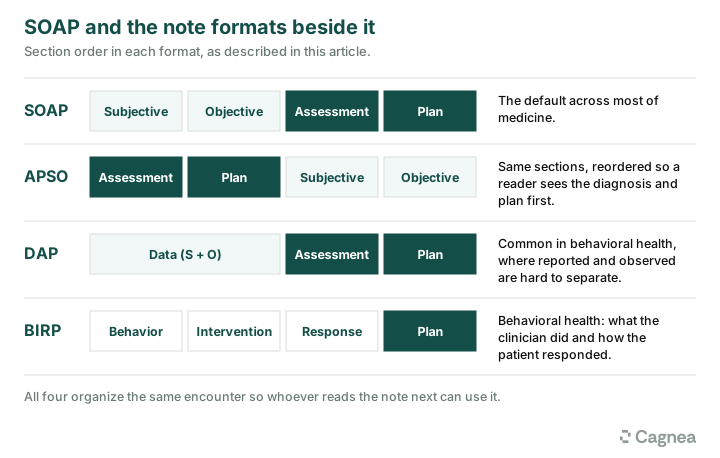
All four formats solve the same problem: organizing a clinical encounter so it’s clear, complete, and usable by whoever reads it next.
Where SOAP came from
SOAP isn’t a convention that simply emerged over time. It traces back to Dr. Lawrence Weed, a physician who later spent much of his career at the University of Vermont. In a 1968 New England Journal of Medicine paper, Medical Records That Guide and Teach, Weed introduced the broader concept of the problem-oriented medical record (POMR). His idea was to organize the record around each of a patient’s individual problems, rather than the loose, free-form charting common at the time.
Weed’s argument went beyond making notes neater. He believed the medical record should actively help clinicians think: make problems visible, separate observations from interpretation, clarify what needs to happen next, make the patient’s course easier to follow, and let another clinician pick up the record without reconstructing the whole story. He also anticipated how structured records could help medicine learn from accumulated patient information, and how computers could eventually make that information more useful.
In other words, Weed wasn’t just proposing a better way to write notes. He was proposing that the medical record should be a tool for thinking, communicating, teaching, and improving care.
Where Cagnea fits
Cagnea is an ambient AI medical scribe that drafts a structured SOAP note from the visit conversation, for the clinician to review, edit and sign. The structure stays the same; the typing doesn’t. You can try it free for 14 days.
Frequently asked questions
What’s an example of a SOAP note?
A short one might read: S: “Patient reports sore throat and mild fever for two days.” O: Temp 100.9°F, pharynx erythematous, tonsillar exudate present. A: Likely streptococcal pharyngitis. P: Rapid strep test ordered, supportive care advised, follow-up if symptoms worsen or persist beyond five days.
Do doctors still use SOAP notes?
Yes, extensively. It’s still the default note structure across most of medicine, even as EHR systems and, increasingly, ambient AI documentation tools have changed how the note gets written. The structure has outlasted several waves of documentation technology because its logic, separating what was reported from what was confirmed, holds regardless of what’s doing the typing.
What does SOAP stand for in nursing charting?
The same four things it stands for everywhere else: Subjective, Objective, Assessment, Plan. Nurses use it for shift notes and progress documentation, though a nursing assessment may lean more on ongoing monitoring and care coordination than a physician’s diagnostic assessment.
What are the four parts of the SOAP method?
Subjective, Objective, Assessment, and Plan, in that order. Subjective and Objective are the inputs, what the patient said and what you confirmed. Assessment and Plan are what you build from them: your interpretation and your next steps.