Pull ten charts at random from any clinic, and you’ll find some variation of the sentence “patient appears anxious” in most of them. Does an observation like that have a place in a note? It absolutely does, but not where you’ll usually find it: in the section meant only for what the patient states, not what “appears” to you.
This is why subjective documentation deserves a closer look. Clinicians know the definition and the boundaries, but still drift from them, because documentation is tedious, and holding on to those boundaries in real time, mid-conversation, while also paying attention to the patient, is genuinely hard.
What is subjective documentation?
Subjective documentation is the part of a clinical note built entirely from what the patient tells the clinician: their symptoms, their history, their feelings, their description of their pain, and what they want from the visit. The clinician’s interpretation and diagnosis have no place here. It is the S in a SOAP note.
Rule of thumb: the source of the information decides the category. If it came from the patient, it’s subjective. If it came from your own observation, an instrument, or a test result, it’s objective.
So how does that play out in a real visit?
Subjective vs objective documentation
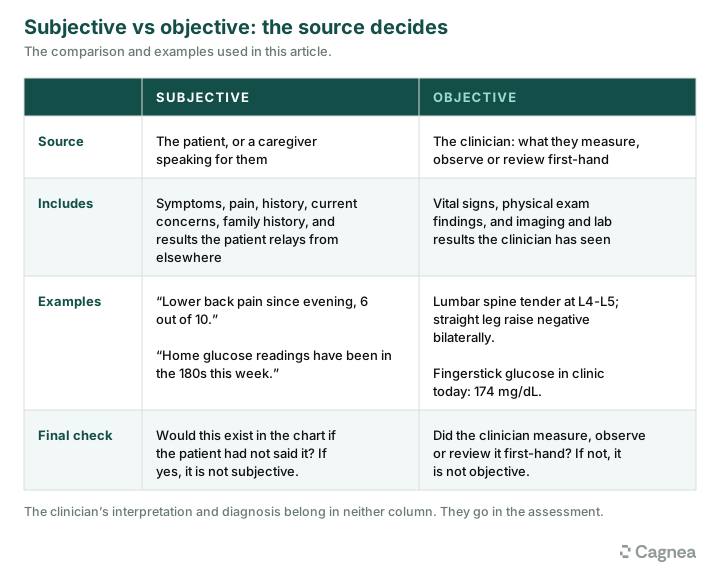
- Subjective: symptoms, pain, history, current concerns, family history, and results the patient relays from elsewhere, all in the patient’s or caregiver’s words.
- Objective: vital signs, physical exam findings, and imaging and lab results the clinician has measured, observed, or reviewed first-hand.
What they are not: objective doesn’t mean “true,” and subjective doesn’t mean “unverified” or “less important.” A patient’s report that their headaches are worse in the afternoon is subjective, and it might be the single most useful piece of information in the chart for finding a trigger. Meanwhile, an objective finding like a normal physical exam doesn’t rule anything out on its own. It is one input sitting next to the patient’s account, not a referee overruling it.
Where the line actually gets blurry
So far, everything looks easy. The definition is clear and the distinctions make sense, which might make you wonder why this needs discussing at all. There are three reasons.
- It records where information came from. Anyone reading the chart later, whether a specialist, a second opinion, an insurer, or your own future self six months from now, needs to know which claims came from the patient and which ones you confirmed. That distinction changes how much weight each piece of information carries.
- Documentation mistakes have legal and financial consequences. They surface in malpractice review: a 2024 Candello benchmarking report found that nearly 20% of medical malpractice cases involve documentation failures, and that such failures more than double the odds of an indemnity payment.
- Some information sounds objective but isn’t. The cases below are where clinicians most often get it wrong.
Case 1: The home monitor reading
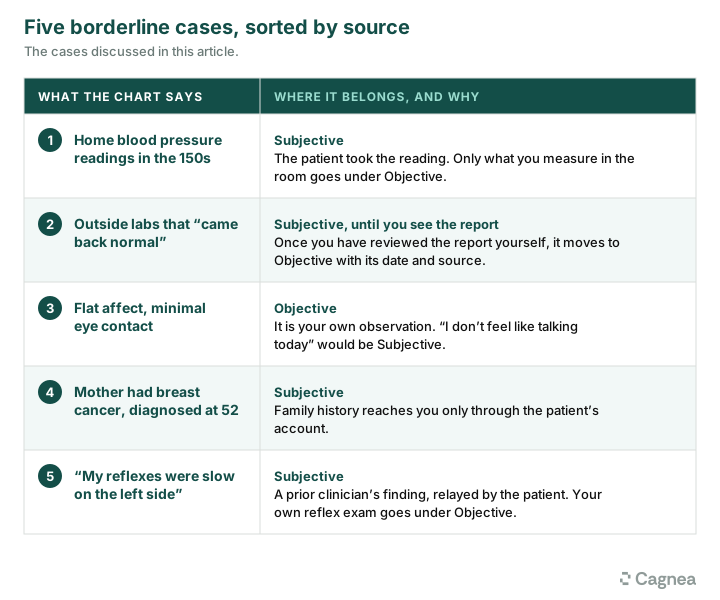
A patient tells you their home blood pressure cuff has been reading in the 150s over the past week. It’s a number, and numbers feel objective. But you didn’t take that reading, you didn’t calibrate that device, and you have no independent verification that it happened the way the patient describes.
Wrong: “BP 150/95 elevated, per patient,” written under Objective as if it were a vital sign you took.
Right, under Subjective: “Patient reports home blood pressure readings in the 150s systolic over the past week, taken on a home cuff.” Then, under Objective, only what you actually measured in the room that day.
The number didn’t change categories because it’s precise. It stayed subjective because the source never changed: it’s still the patient telling you something, not you confirming it.
Case 2: The outside lab result
A patient mentions they had bloodwork done at an urgent care visit last month and that “everything came back normal.” This is two different situations, depending on one fact: did you see the actual report, or only hear the patient’s summary of it?
Wrong: “Recent labs WNL,” written as a confirmed, objective fact with no source.
Right, if you never saw the report: under Subjective, “Patient reports outside labs drawn last month, results relayed as normal; records not yet obtained.”
Right, if you pulled the report yourself: it belongs under Objective, cited with the date and source, because you’ve verified it rather than taking the patient’s word for it.
Case 3: The observation that looks emotional but isn’t the patient’s report
This one catches experienced clinicians off guard, because it runs in the opposite direction. A note reads: “Patient appeared flat, minimal eye contact, answered in short sentences throughout the interview.” It describes mood and affect, which sounds subjective, but it’s objective, because it’s your direct behavioral observation, not the patient’s self-report.
Wrong: filing that description under Subjective because it’s about how the patient seemed emotionally.
Right: it belongs under Objective. It only becomes subjective when the patient says something like, “I don’t feel like talking today, I’m exhausted.”
One sentence is your read of the room. The other is the patient’s own account. They can sit next to each other in the chart and still belong in different sections.
Case 4: Family history relayed secondhand
A patient tells you their mother had breast cancer, diagnosed at 52. It has the texture of a hard medical fact, with a relationship, an age and a diagnosis, but it’s still subjective, because it reaches you only through the patient’s account of someone else’s history.
Wrong: listing it in the chart with the same weight as a lab value, with no attribution.
Right: “Patient reports maternal history of breast cancer, diagnosed at age 52.” Still subjective, still entirely appropriate to document and act on, just labeled as the patient’s account rather than a verified record.
Case 5: The patient repeating a prior clinician’s finding
A patient says, “The doctor I saw last week told me my reflexes were slow on the left side.” It’s a physical exam finding, but it reached you secondhand, through the patient’s memory of what another clinician said. You didn’t test the reflex, and you’re not confirming what the prior clinician found, only what the patient remembers being told.
Wrong: documenting “decreased left-sided reflexes” under Objective, as if you’d tested it yourself.
Right: under Subjective, “Patient reports being told by a prior provider that left-sided reflexes were decreased; not independently confirmed today.” If you then test the reflex yourself, that finding, whatever it turns out to be, belongs under Objective as your own.
Why clinicians get it wrong in real time
If the rule is this learnable, why does the blending happen so often, even among clinicians who could recite the definition on a test? The reasons are structural, not a failure of knowledge.
1. You’re already diagnosing while you’re still listening
By the time a patient finishes describing a symptom, an experienced clinician has usually formed a working impression. Separating that real-time interpretation from the patient’s own statement takes a deliberate pause that most visits don’t have room for.
2. Fatigue erodes precision on long shifts
The fifteenth patient of a twelve-hour shift gets a subjective section built from muscle memory and boilerplate, because by then there’s little cognitive bandwidth left to apply the rules carefully.
3. Patients blur the categories without meaning to
A patient narrating their history will naturally mix in things that sound like exam findings: “my blood pressure runs high,” “my doctor said my heart sounded fine last time,” “I think my white count was elevated.” None of that is wrong for the patient to say, but it leaves the clinician sorting, mid-sentence, which parts are the patient’s own experience and which are secondhand exam or lab data.
4. Throughput pressure rewards speed over precision
In a visit built around a fixed number of minutes per patient, the fastest way through documentation is to write an impression once and let it stand in for both what was reported and what was found. Correcting that habit costs time on every note, which is the resource that’s scarcest in a packed schedule.
None of these reasons points to a lack of knowledge. It’s the weight of the workload that leads to compromises in documentation.
Where ambient AI helps
This is the gap ambient clinical documentation tools were built to close.
An ambient AI scribe like Cagnea listens to the full visit as it happens and builds the note afterward, so the clinician doesn’t have to make the subjective-versus-objective call in the split second between one sentence and the next. The sorting happens after the conversation is captured, not during it, which removes the condition, real-time synthesis under time pressure, behind most of the blending described above.
It also helps with paraphrase. Because the system has the full conversation rather than rushed mid-visit shorthand, a patient’s own phrasing, “like an elephant sitting on my chest,” “it feels like rocks are inside my knee,” can stay in the note where it matters, instead of being flattened into generic clinical language.
None of that removes the need for clinical judgment. The clinician still reviews and finalizes every note, still decides what belongs where, and still owns the chart. What changes is where the pressure sits: the system does the first pass with the whole conversation available, and the clinician’s job becomes review and correction rather than transcribing and categorizing at the same time. That’s an easier task, and it gives the subjective section a better chance of being complete and accurate.
If you want to take documentation off your plate without losing accuracy in your subjective sections, try Cagnea free for 14 days.