

When a patient decides to leave the emergency department (ED) before the recommended evaluation or treatment is complete, the doctor must respect the patient’s right to make decisions while ensuring they understand the risks. Good documentation of leaving against medical advice (AMA) should capture the clinical assessment, decision-making capacity, discussion of risks, alternatives offered, and follow-up advice. An AMA form is part of this process; it is not a substitute for the conversation.
What does leaving against medical advice mean?
Leaving against medical advice refers to a patient choosing to leave a healthcare facility or refuse recommended treatment before the treating team considers the evaluation or care complete. In the ED, this may happen before investigations are finished, treatment is given, or a specialist has assessed the patient.
Why do patients leave the ED before treatment is complete?
In the emergency departments where I have worked, financial constraints have been one of the most common reasons I have encountered for patients leaving against medical advice. Admission, investigations, medications, transport, and time away from work can place a significant burden on patients and their families. For someone who earns a daily wage, staying in the hospital may mean losing income as well as paying for treatment.
Other reasons include long waiting times, family or work commitments, fear of a procedure or diagnosis, feeling better and believing further evaluation is unnecessary, or disagreement with the proposed plan. Some patients may also prefer to seek care elsewhere or have lost trust in the treating team.
Explore these reasons rather than assuming them. Some patients may reconsider if a specific concern is addressed. Re-explain the plan, discuss reasonable alternatives, involve a family member with the patient’s permission, or contact social work or financial counseling when available.
There is also a wider health-system issue. When financial constraints determine whether a patient can complete necessary treatment, documentation alone cannot solve the problem. Greater access to affordable care and progress toward universal health coverage can reduce the number of patients forced to choose between medical care and financial security. This will not prevent every AMA discharge, but it addresses an important barrier before it reaches the bedside.
Assess decision-making capacity before accepting refusal
A patient who wants to leave should not automatically be considered incapable of making decisions. Equally, being alert, oriented, and able to sign a form does not automatically establish decision-making capacity.
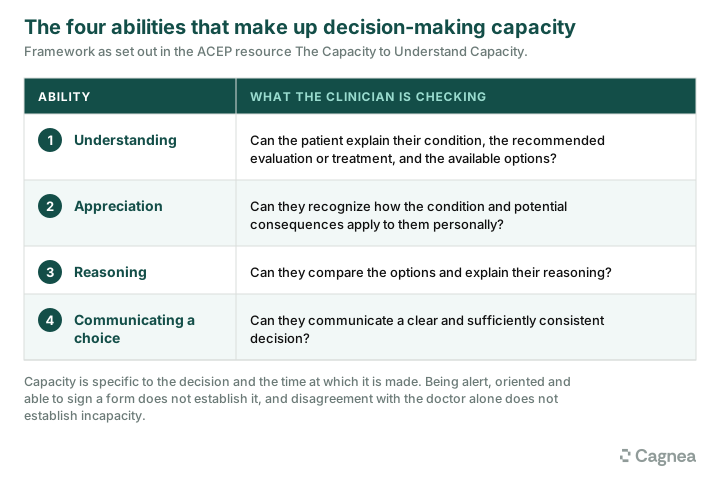
Capacity is specific to the decision and the time at which it is made. A commonly used framework considers four abilities:
- Understanding: Can the patient explain their condition, the recommended evaluation or treatment, and the available options?
- Appreciation: Can they recognize how the condition and potential consequences apply to them personally?
- Reasoning: Can they compare the options and explain their reasoning?
- Communicating a choice: Can they communicate a clear and sufficiently consistent decision?
These domains are discussed in the American College of Emergency Physicians (ACEP) resource, The Capacity to Understand Capacity.
In practice, ask the patient to explain the situation in their own words rather than simply asking whether they understand. If a patient wants to leave before a potentially serious condition has been ruled out, ask why further evaluation was recommended and what they understand could happen if they leave.
Consider factors that may temporarily affect capacity, including delirium, hypoxia, hypoglycemia, intoxication, medication effects, severe pain, or an acute neurologic or psychiatric condition. Address reversible factors and reassess where appropriate.
Disagreement with the doctor alone does not establish incapacity.
If a patient lacks capacity for the decision, the team must consider the urgency of the condition, applicable law and hospital policy, and appropriate involvement of a legally authorized surrogate where relevant. Emergency treatment and any restriction on departure must follow the applicable legal and ethical framework; an AMA form is not a substitute for this assessment.
For a practical discussion, see ACEP Now’s article, Can This Patient Leave Against Medical Advice?.
The conversation matters more than the signature
Once capacity has been assessed, the next step is a clear discussion. The aim is not to frighten the patient into staying, but to give them the information needed to make an informed choice.
The discussion should cover:
- The clinical concern: Explain what is known, what remains uncertain, and why further evaluation or treatment is recommended.
- The risks of leaving: Explain the material risks relevant to the patient, rather than relying on vague statements such as “your condition may worsen.”
- The benefits of staying: Describe what the recommended investigations, treatment, or observation are intended to achieve.
- Alternatives: Explore reasonable alternatives if the patient declines the recommended plan, including transfer where appropriate.
- Follow-up and return precautions: Explain where to seek care and which symptoms require an immediate return.
Give the patient an opportunity to ask questions. Where possible, ask them to explain their understanding in their own words. This teach-back approach can reveal misunderstandings that a simple “Do you understand?” may miss.
Even if the patient remains unwilling to stay, offer appropriate care within the circumstances, provide reasonable discharge advice, and make it clear that they can return for further assessment.
Language is a patient-safety issue, not a formality
Another issue that deserves more attention in AMA documentation is the language used for the discussion and the form itself.
In a busy ED, patients may be asked to sign standard forms written in English even when they cannot comfortably read them. I have seen the practical problem this creates: a patient may sign a document without fully understanding what it says. The discussion and written information should be accessible to the patient, not merely completed for the record.
The treating team should identify the patient’s preferred language and communicate in a language the patient understands, using a qualified interpreter when needed and available. Written information should also be provided in a language the patient can read. Document the language used, whether an interpreter assisted, and how understanding was checked. A family member may help in some circumstances, but should not automatically replace appropriate interpreter support, particularly for high-risk decisions.
The AHRQ guide to improving patient safety for people with limited English proficiency discusses qualified interpreters, translated materials, and teach-back for high-risk interactions, including informed consent and discharge.
An integrated documentation system with a reliable translation function could help clinicians explain the patient’s condition, the risks of refusal, and follow-up advice in the patient’s preferred language. This could reduce the practical burden of preparing translated documents during a busy shift.
Automated translation should support, not replace, clinical communication. High-risk wording needs appropriate validation and clinician review, and patients must still be able to ask questions and demonstrate understanding. A translated form is not enough if the patient has not understood the explanation.
What should an AMA note contain?
The note should reflect the clinical situation and the discussion that actually took place. A useful record includes:
- Clinical assessment: Presenting complaint, relevant findings, working diagnosis or differential, investigations completed, and tests or treatment pending.
- Reason for leaving: Record the patient’s stated reason, ideally in their own words. Document financial concerns and any assistance or alternatives explored.
- Decision-making capacity: Record the assessment of understanding, appreciation, reasoning, and ability to communicate a choice. Note factors that could affect capacity and steps taken to address them.
- Risks and benefits discussed: Document the specific risks of leaving, the expected benefits of continued care, and remaining uncertainty.
- Alternatives offered: Include alternatives discussed, the patient’s response, and any attempt to address their concerns.
- Language and understanding: Record the language used, interpreter involvement, and how comprehension was assessed.
- Plan and disposition: Document prescriptions where appropriate, follow-up arrangements, return precautions, the patient’s final decision, and the circumstances of departure.
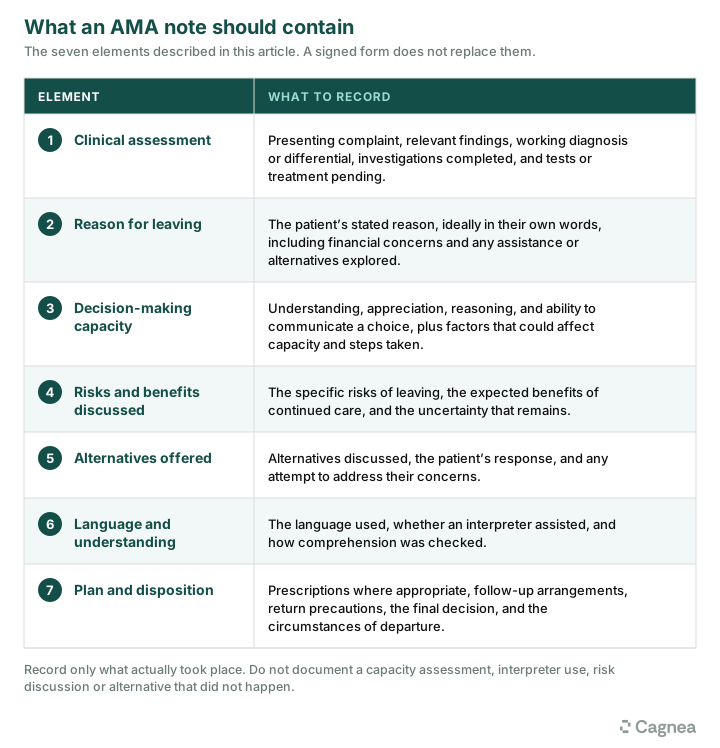
A signed AMA form may be included in the record, but should not replace these details. The AHRQ Patient Safety Network discussion on discharge against medical advice also highlights capacity, communication, follow-up, and documentation as important safeguards.
Example: an AMA note
The following is an illustrative example, not a universal template.
Clinical assessment: A 65-year-old patient with diabetes mellitus and hypertension presents with typical chest pain of 30 minutes’ duration. Initial ECG is normal, and point-of-care troponin is within the normal range. Serial troponin testing and continued ECG monitoring are advised to evaluate for acute coronary syndrome; assessment remains incomplete.
Reason for leaving: Patient wishes to leave due to concerns about the cost of continued care.
Capacity and discussion: Patient communicates a consistent choice and explains the recommendation for serial testing. Discussed that a normal initial ECG and point-of-care troponin do not exclude acute coronary syndrome. Risks of leaving before completion of evaluation, including missed myocardial infarction, deterioration, and death, are explained. Benefits of continued monitoring and testing, available alternatives, and financial assistance options are discussed where possible. Patient continues to decline further evaluation.
Language: Discussion conducted in the patient’s preferred language. Understanding checked using teach-back; interpreter details documented if applicable.
Plan: Patient advised to return immediately for persistent or recurrent chest pain, breathlessness, sweating, syncope, or worsening symptoms. Follow-up and available options explained. Patient leaves before recommended evaluation is complete.
The note must reflect what actually occurred. Do not document a capacity assessment, interpreter use, risk discussion, or alternative that did not take place.
Common myths about leaving AMA
Myth 1: A signed AMA form protects the doctor, and the patient is no longer the team’s responsibility
A signature does not, by itself, establish capacity or understanding. The team should still offer reasonable care, discuss alternatives, provide instructions, and explain when to return. Accurate documentation and appropriate clinical care remain essential.
Myth 2: Every patient who leaves early is an AMA discharge
A patient leaving before a planned assessment, refusing one particular test, and leaving after a complete evaluation are not necessarily the same situation. The record should describe what happened rather than applying the label automatically.
Myth 3: A patient who is oriented has decision-making capacity
Orientation is useful, but it does not assess all four domains. The clinician must assess the patient’s ability to understand, appreciate, reason, and communicate a choice about the specific decision.
Documentation, continuity, and the role of technology
AMA documentation is often completed during a busy shift, when important details can be missed. Electronic-record prompts can help clinicians capture capacity, risks discussed, alternatives offered, language support, and return precautions without making the process unnecessarily time-consuming.
Tools such as Cagnea may help structure documentation and support translation, but they should not generate details that were never discussed or replace the clinician’s assessment. The aim is to make good documentation easier to complete consistently, while leaving the clinical decision and conversation where they belong—with the treating team and the patient.
Frequently asked questions
Can a patient leave against medical advice if the doctor recommends admission?
A patient with decision-making capacity generally has the right to refuse recommended care. The clinician should explain the risks and alternatives and document the discussion. Situations involving impaired capacity or other legal considerations require assessment under applicable law and policy.
What should an against medical advice form include?
It should support documentation of the patient’s decision, clinical concerns and risks explained, capacity assessment, alternatives offered, language assistance, and follow-up advice. A form alone is not enough.
What if the patient refuses to sign the AMA form or cannot understand it?
Document the patient’s decision, the discussion, and the reason for refusing to sign if known. If the patient cannot understand the form, use appropriate language assistance and explain it in a language they understand. Record the language used, interpreter involvement, and how understanding was checked. Follow hospital policy.
The takeaway
An AMA discharge is not complete simply because a form has been signed. The priority is to assess capacity, explain the material risks and alternatives in a language the patient understands, document what actually occurred, and keep the route back to care open.
Cagnea is built to make that record easier to finish during the shift rather than after it, with structured prompts for capacity, risks, alternatives, and return precautions, and translation that stays under clinician review. Current plans are listed on the pricing page.


